
News

P.E.I. oyster industry says announced government supports will help, but there’s still more to do

This article was written by Kristin Gardiner and originally published by Journal Pioneer on May 13, 2026. We are sharing the full text here for reference. All rights remain with the original publisher.

Thomas Burleigh, leader of the P.E.I. NDP, stands next to a pile of oyster shells in behind his business, Burleigh Bros. Seafood. Photo by Kristin Gardiner /Journal Pioneer
MILL RIVER, P.E.I. — For the second spring in a row, Islanders in the oyster industry are battling high oyster mortality rates, with many fearing financial losses and what the future holds.
As of mid-May, both the provincial and federal governments have announced supports aiming to alleviate some of the stress and challenges and ensure the continuation of oyster growing, fishing and processing.
First discovered in P.E.I. in July 2024, MSX — multinucleate sphere unknown x — is a lethal disease that impacts oysters, with an estimated mortality rate of around 90 to 95 per cent. It has been found in oysters in Bedeque Bay, Foxley River and Cascumpec Bay.
Another disease, dermo, was confirmed in P.E.I. a year later.
Monique Horne is an oyster grower out of Foxley River, as well as the vice president of the Island Oyster Grower Group. She has been involved in growing since she was a child, and there are three generations presently working together.
This year, the diseases hit the family hard.
“We’re looking at 100 per cent mortality on our farm,” she said. “We did expect to see some mortalities when we were sinking our cages last fall. We knew that there would be some loss, but we didn’t prepare for the full load to be gone.”

Monique Horne is an oyster grower who says her family’s farm has experienced a total loss this year, due to the lethal diseases killing oysters in P.E.I. Photo by Kristin Gardiner /Journal Pioneer
Assistance like the federal government’s approval of broodstock imported from the United State to help develop disease-resistant oysters, Horne said, is welcome though the oyster industry will still face commercial losses.
“To have that help, it’s just gonna make a big difference,” she said. “With peace of mind, for one thing, but then also that financial strain. Because we know that we’re not gonna have a harvest again for minimum three years — that’s, providing this seed import works.”
Providing aid
Other supports the federal government announced May 8 include a $4.2 million investment to help cover the cost of disease-resistant seed, $130,000 invested in developing a strategy for a response to the disease and a one-time license buy-back for affected licenses.
And, on May 12, the provincial government announced supports of its own.
Per Fisheries Minister Ernie Hudson, the province will be continuing programs such as the oyster growers income stabilization program.
It is also introducing an oyster industry interest relief program, providing up to $3 million to help cover interest costs on loans taken out before May 1, or for those who have experienced at least 30 per cent losses.
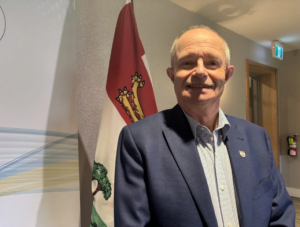
Fisheries Minister Ernie Hudson hopes that the supports announced by the provincial government will help revitalize P.E.I.’s oyster industry, and said that it’s important the government work with relevant groups and associations to ensure they are providing the right supports, and that they are useful. Photo by Kristin Gardiner /Journal Pioneer
“The goal, ultimately, is to get this industry back to where it was pre-MSX and dermo,” said Hudson.
“Unfortunately, it’s not something that’s going to take place or occur overnight. It is going to take time. The important thing, I truly feel, is (that) we work with the different industry partners.”
Zack Bell, minister of workforce and advanced learning, also announced the continuation of the oyster fishers training fund, as well as the introduction of the oyster relief wage assistance program.

Zack Bell, minister of workforce and advanced learning, announced the continuation of the Oyster Fishers Training Fund, as well as the introduction of the Oyster Relief Wage Assistance Program. It’s important, he says, that those currently working in the industry remain employed. Photo by Kristin Gardiner /Journal Pioneer
The latter is intended to offset some payroll costs to help retain employees, while businesses face increased sorting and handling requirements due to the presence of MSX.
“It is an uncertain time,” said Bell. “We talk about the resiliency of the industry and the people who are in it, but at the same time, it’s a lot more work, actually, dealing with the mortalities, that’s what I’ve heard from some of the processors and some of the growers.
“We feel that these supports will be able to help keep people in the industry when the industry does get through MSX and dermo.”
Industry response
Despite the continuing and new assistance, not everyone is fully satisfied.
Before the supports were announced, P.E.I. NDP leader Thomas Burleigh had called upon the governments to provide financial assistance.
He is a member of a number of shellfish-related associations, and is the general manager of Burleigh Bros. Seafood — where about 65 to 70 per cent of the seafood they deal with is oysters, around 90 per cent of which are wild.
As such, it’s not just politics for him. Fewer oysters coming in has meant concerns regarding the amount of product the business can send out. While they sell quahogs, too, it’s not enough to make the difference.
After the federal government announced its supports, Burleigh told the Journal Pioneer that he felt they were vague and didn’t come with much of a stability plan to revitalize the wild fishery.
“We were kind of hoping for more efforts on things like shellfish enhancement, or organizations like the P.E.I. Shellfish Association with good access to hatcheries and nurseries and disease-resistant seed, themselves,” he said. “But it just seems like the feds are only interested in buying them out. That’s what it feels like to a lot of people in the industry right now.”
In speaking with those in the industry, Burleigh said many, particularly the smaller-scale growers, are feeling anxious for the future.
“There’s three, four of them that I’ve talked to who are basically three or four months away from bankruptcy,” he said. “A lot of them have had their leases completely wiped out. They have lines of credit with the province, or with private lenders, and they’re worried.”
Left behind
Bob MacLeod, president of the P.E.I. Shellfish Association, said that he feels as though the wild industry is being left behind. The cost of disease-resistant seed, he said, is more beneficial to growers.
“There was no support for it,” said MacLeod in a May 8 interview, following the announcement of the federal supports. “The only thing was they’ll buy our license, and that’s it. We got nothing.”
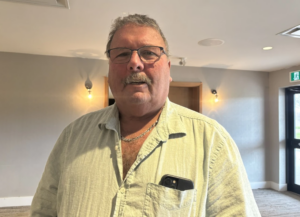
Bob MacLeod, president of the P.E.I. Shellfish Association, said that he feels as though the wild industry is being left behind, as many announced supports are more beneficial to processors or growers. He hopes, though, that wild oyster fishers will be able to benefit from the announced wage assistance program. Photo by Kristin Gardiner /Journal Pioneer
While MacLeod noted that the buy-back would be beneficial to those who want that option, it’s not one size fits all. He doesn’t see it as a solution for those who’ve been in the wild oyster industry for decades, who might not have any other options or want to walk away.
As for the provincial supports, he at least hopes the fishers will be able to benefit from the wage subsidy to keep them on the water. Still, MacLeod thinks there is more to be done and wants to see specific measures to assist the wild oyster industry.
While he plans to continue fishing for a while, if MSX continues to ravage the oyster industry without additional supports for wild fishers, he said he’s not sure how much longer he’ll be able to stay.
“All these programs that are coming out, it’s not really hitting what our need is,” said MacLeod. “It’s too bad. This wage subsidy, hopefully we will get a little bit out of that. But other than that, there’s not much for us.”
Source: Journal Pioneer. Original article available here.
Recent News
This article was written by Maria Sarrouh and originally published on May 25th 2026 at 5:00am EDT. ALBERTON, P.E.I. –…
This article was written by Sean Mott and originally published by CP24 on May 17th 2026 at 5:00AM EDT. We…
This article was written by Kristin Gardiner and originally published by Journal Pioneer on May 13, 2026. We are sharing the full text…
This article was written by Sean Mott and originally published by CTV News on May 12th 2026 at 12:01…
This news release was originally published by ACOA on May 8, 2026. We are sharing the full text here for…
This article was originally published by The Guardian on May 8th, 2026. We are sharing the full text here for…
This article was written by Lucas McInnis and originally published by CBC on April 29th, 2026 at 6:00am ADT. We…
This article was originally published by CBC News on April 27, 2026. We are sharing the full text here for…
This article was originally published by RPC on February 19, 2026. We are sharing the full text here for reference.…
This article was originally published by CBC News on Jan 29, 2026. We are sharing the full text here for…